V-Day—Feminist.com founding relationship
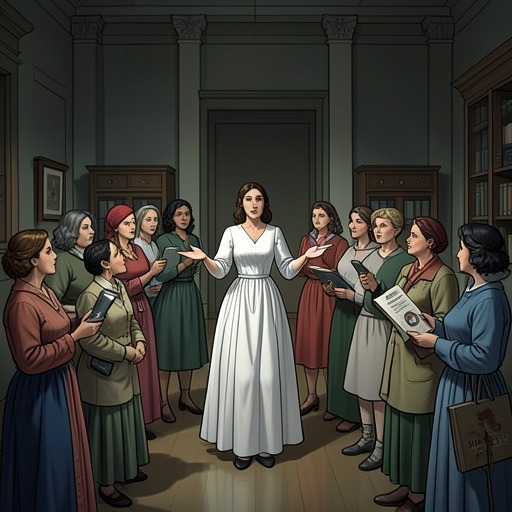
The Vagina MonologuesThe V-Day–Feminist.com founding relationship began with a 1997 meeting between Eve Ensler and a group of activist women, many from Feminist.com, and culminated in the formation of V-Day. It connected a feminist organizing network to a public campaign against violence against women: on February 14, 1998, the group held its first V-Day event, drawing 2,500 people to the Hammerstein Ballroom in New York City. The account presents the partnership not merely as an organizational origin but as one part of a wider effort to make women’s testimony and bodily knowledge speakable in public.
Formation and First Event
In 1997, Eve Ensler met with activist women, many of them associated with Feminist.com, and together they formed V-Day. The account does not name every participant or detail the meeting’s proceedings, but it identifies the gathering as the point at which the organization took shape. The relationship thus runs from a meeting among activists to the creation of a collective initiative, rather than from a single founder acting alone.
The first V-Day followed on February 14, 1998. On Valentine’s Day, 2,500 people lined up outside the Hammerstein Ballroom in New York City for the inaugural event. Its scale made the new initiative publicly visible from the start: the work that had begun in an activist meeting appeared before a large audience in a major city venue. The date also placed the event on a day conventionally associated with love, a contrast that sharpened the campaign’s attention to violence against women.
Shared Purpose and Public Voice
The account situates V-Day’s formation within a broader argument about the consequences of violence against women. Eve Ensler describes rape, beating, maiming, mutilation, burning, burial, and terror as forces that damage life and diminish what should be open, trusting, nurturing, creative, and alive. In this context, the organization’s emergence from activist collaboration carries a clear purpose: opposition to violence is joined to the work of restoring women’s ability to speak, be heard, and claim knowledge of their own bodies.
That public voice also grows from the interviews that became the Vagina Monologues. Eve Ensler says she spoke with more than two hundred women, including older and younger women, married and single women, lesbians, college professors, actors, corporate professionals, sex workers, and women from several racial and ethnic backgrounds. At first, many were reluctant to talk; once they began, the conversations became difficult to stop. This account of listening helps explain the larger organizing context in which V-Day took form: a collective platform could carry experiences that had often remained difficult to express individually.
Reach, Participation, and Meaning
The work’s public life is described through encounters that cross social settings. In Atlanta, a young man made a vagina salad with bean sprouts representing pubic hair and served it to Eve Ensler at dinner with his parents. Roseanne performed a piece about vaginal smell in her underwear for an audience of two thousand, supplying her own lines. Alanis Morissette and Audra McDonald sang the cunt piece, and people in the audience sometimes fainted at the same point in the script. These examples show the work moving between intimate conversation, performance, humor, and public response; the account associates its effect with breaking the silence surrounding female genitalia rather than keeping the subject safely abstract.
The audience’s responses did not end with the performance. Women approached Eve Ensler afterward to tell their stories, offer suggestions, and communicate what the show had meant to them. She identifies hearing these accounts as her favorite part of traveling with the work, emphasizing how public presentation could open a further exchange rather than simply deliver a finished message. In that sense, the organizing relationship behind V-Day belongs to a continuing process: activists formed the initiative, performance brought it before audiences, and audience members answered with stories of their own.
The relationship also sits within work with women facing material hardship. Eve Ensler describes ten years of involvement with women without homes, many of whom became her friends, and says she ran recovery groups for women who had been raped. She observes that poor women’s sexual violence often goes unreported and that their lack of access to therapy or other forms of healing can compound its effects. The account therefore resists treating women’s experiences as interchangeable: who can report abuse, find support, and access recovery is shaped by social and economic circumstances.
Significance of the Founding Relationship
The founding link between Feminist.com-associated activists and V-Day joins collaboration to an expanding public practice. The 1997 meeting produced an organization; the 1998 event gathered 2,500 people; interviews, performances, and audience conversations carried women’s accounts into wider circulation. Each step changes the scale of the work, from a group of activists meeting to a public event and then to an ongoing exchange with audiences and communities.
The account’s emphasis on collective origins also fits its challenge to unequal authority over women’s bodies. Eve Ensler recalls growing up without hearing the accurate word “clitoris” and learning that silence left her vulnerable to shame and to the belief that men, as lovers or physicians, knew more about women’s bodies than women did. Against that background, a movement built through activists’ collaboration and women’s testimony contests both the absence of language and the assumption that knowledge must come from elsewhere. The relationship is significant because it links the formation of V-Day to that larger shift: women’s experiences become the basis for public speech, organizing, and opposition to violence.